











The Galerie Montmartre
Open Monday to Sunday, from 9:30am to 6:30pm




Price on request
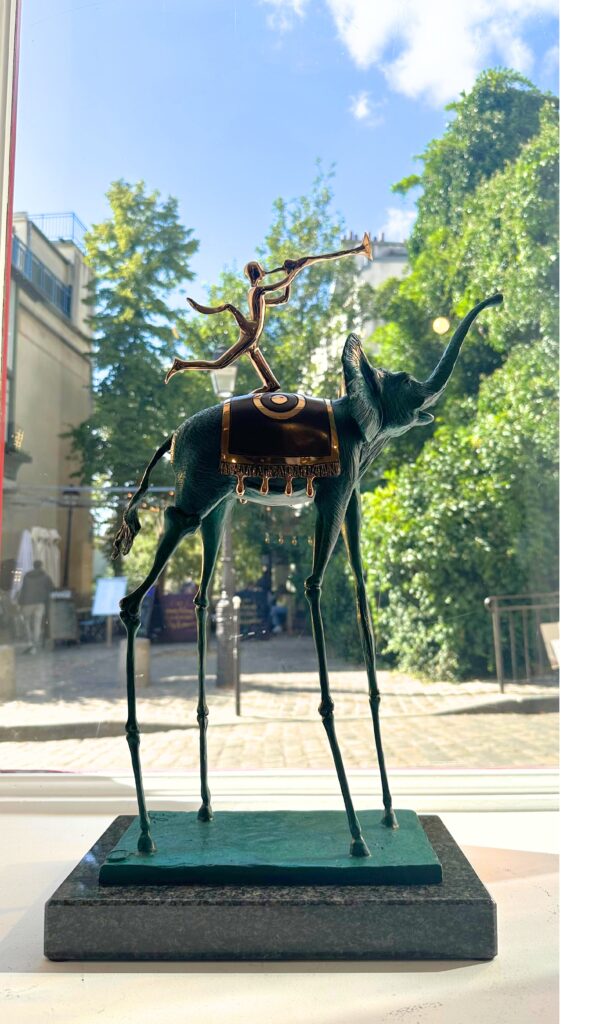
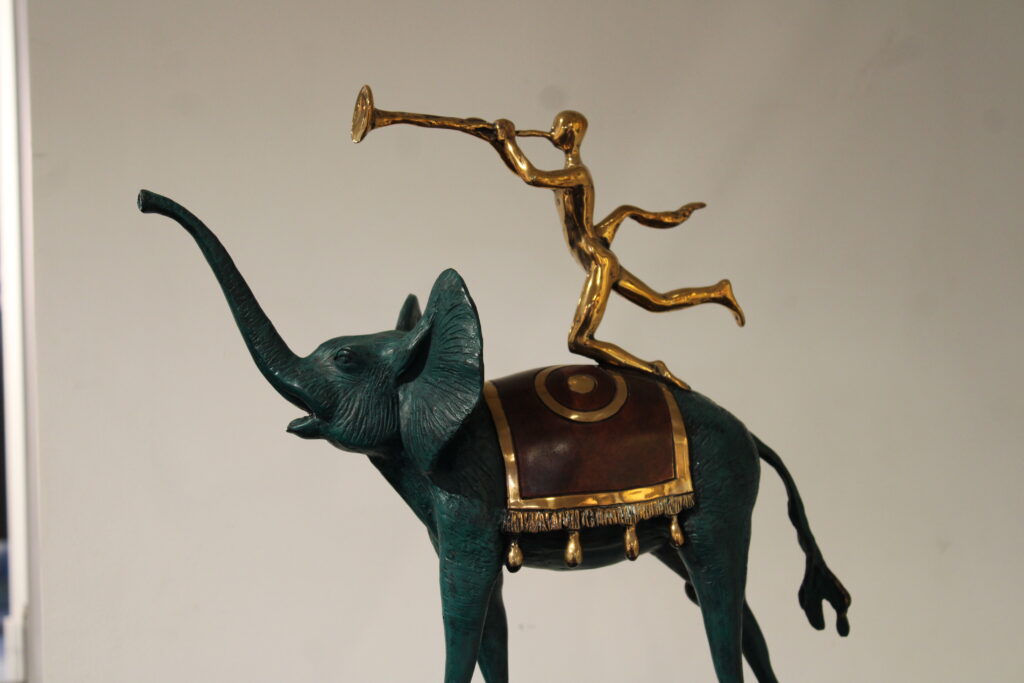
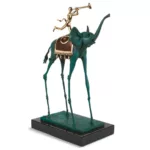
The elephant, Dalí’s symbol of the future, is one of his favourite images, often typically depicted carrying objects on their backs. Dalí subverts the idea of the elephant being heavy and strong, by giving it impossibly long legs. It is an example of pure Daliesque whimsy, a fantastic image created by juxtaposing the immense weight with the fragility of the thin joints. There is a sense of otherworldliness as Dalí’s elephants defy the laws of nature moving effortlessly, almost gracefully.
These spindly legs remind us of stilts and crutches, which Dalí used so often in his work. The elephant was a recurring theme, first appearing in his 1944 painting Dream Caused by the Flight of a Bee Around a Pomegranate a Second Before Awakening. The Triumphant Elephant is one of the artist’s most iconic and instantly recognizable images.
The figure resting lightly on the pachyderms back is an angel, an image which featured widely in Dalí’s oeuvre. In Dalinian psychology, the messenger represents the subconscious that guides man through life. The elephant raises his trunk triumphantly as the jubilant herald mirrors this action trumpeting success and hope for the future.
| Date / Year | 1975 |
| Technique | bronze, lost-wax |
| Materials | Marble, Bronze |
| Dimensions | 53 cm |
| Condition | excellent |
| Signature | engraved |
| Foundry | Perseo (CH) |
| Edition Information | numbered on 350 |
| Reference | R. N. Descharnes Salvador Dalí Sculptures Objects. Eccart. Ref. 651, page 252. |

Delivery throughout France and internationally
Insurance included for your artworks
FRANCE – BELGIUM – NETHERLANDS – LUXEMBOURG
Salvador Felipe Jacinto Dalí y Doménech was born in 1904 in Figueras, Spain. A painter, sculptor, and author, he is considered one of the most distinctive representatives of surrealism and icons of the 20th century.
Influenced by Impressionism, he began his artistic training at the academy in Madrid. On the advice of Miro, he then left for Paris, where he joined the Surrealist group. There he met his future wife, Gala, his “surrealist muse” and the inspiration for his life and work.
Dalí found his unique style around 1929 when he invented the paranoiac-critical method. His works revolve around the themes of dreams, sexuality, his wife Gala, and religion.
The sculptures of Salvador Dalí
In the 1930s, Dalí began experimenting with three-dimensional art and sculpture. His desire was to translate the fetishes and obsessions of his unconscious into volume and solid matter. He thus recreated the major themes of his pictorial work in the form of sculptures. These sculptures were made using the lost wax technique, a process that allows for perfect precision in bronze modeling.
They represent a significant aspect of Dalí’s artistic creation and provide a synthesis of his interest in form. These bronze sculptures are effectively surrealism in the third dimension.
Galerie Montmartre since 2016, with a permanent representation in France and across international art fairs. The gallery handles international, door-to-door delivery with insurance.
Open Monday to Sunday, from 9:30am to 6:30pm