The Galerie Montmartre
Open Monday to Sunday, from 9:30am to 6:30pm

Andy Warhol (born Andrew Warhola), born on August 6, 1928, in Pittsburgh, Pennsylvania, and died in New York City on February 22, 1987, was an American artist, pioneer, and central figure of Pop Art.
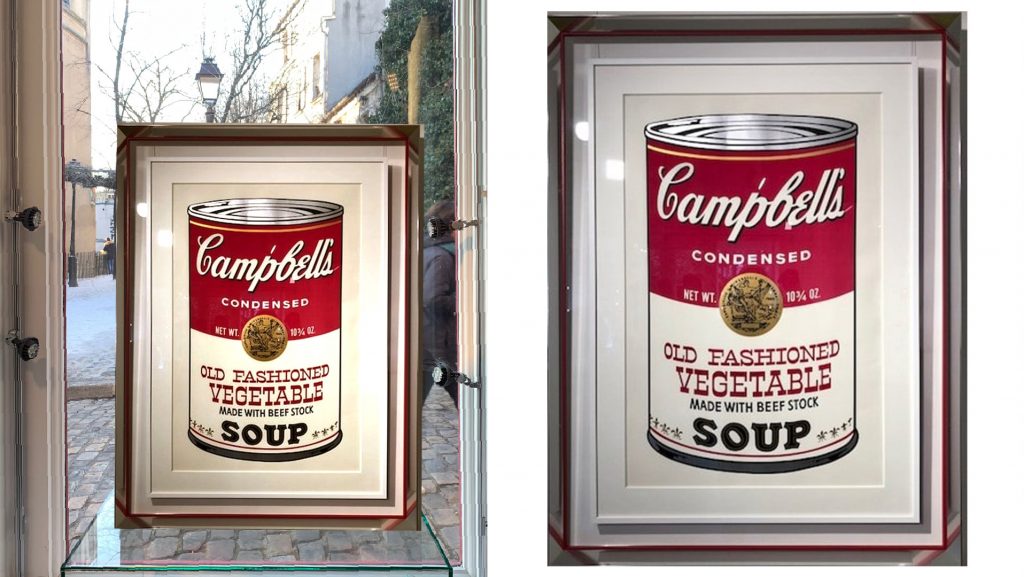
Warhol is known worldwide for his work as a painter, music producer, author, avant-garde filmmaker, and for his connections with intellectuals, Hollywood celebrities, and wealthy aristocrats. The pieces in his “Campbell’s Soup II” series revolutionized the Pop Art movement and remain among his most recognizable works to this day. He took the icon of the American pantry, a symbol of capitalist prosperity, and transformed it into art.
A revolutionary period
Pop Art and Warhol began in what the British called the sixties, i.e. the 1960s. This decade was marked by the student revolts of May 1968, the end of colonialism, and the unprecedented rise of mass consumption. The young people of the sixties were said to be the children of Marx and Coca-Cola.
Among the important events of this period, the following are worth noting: the Vietnam War, the Cultural Revolution in China, the Prague Spring, the Algerian War, decolonization in Africa, the assassination of Kennedy, May 1968, the Woodstock Festival, the Cuban Missile Crisis, Rock ‘n’ Roll and the hippie movement, and in 1969, man’s first steps on the moon.
The upheaval of Pop Art
Pop Art is an artistic movement that originated in Great Britain in the mid-1950s. A rift emerged between young artists and art schools whose teachings no longer reflected the realities of life. A generation of post-war children rebelled against the “Establishment.” In the early 1960s, this quest for renewal gave rise to Pop Art.
With Warhol, Lichtenstein, Rauschenberg, Gill, and Johns, it was mainly the American branch that popularized this artistic movement, which became major, by aggressively questioning mass consumption. The main idea was to present art as a simple consumer product.
From the pantry to the work of art
Warhol was captivated by the imagery of the Campbell’s Soup brand, which he considered visually striking because the design had remained unchanged for decades. Fascinated by this everyday object, Warhol wanted to elevate it to the status of art. In his view, this was already what it represented in American mass culture.
In 1962, the artist exhibited his “Campbell’s Soup Cans” for the first time at the Ferus Gallery in Los Angeles. The 32 paintings were arranged as if on supermarket shelves.
No one knows exactly why Warhol created his Campbell’s Soup series. Some suggest it was a critique of overconsumption, others point to his nostalgia for family life or his naive love of mass culture. It is possible that these works are simply a reflection of the artist’s personality, i.e., a product of consumer society—let’s not forget that he was a publicist before becoming an artist!
Open Monday to Sunday, from 9:30am to 6:30pm